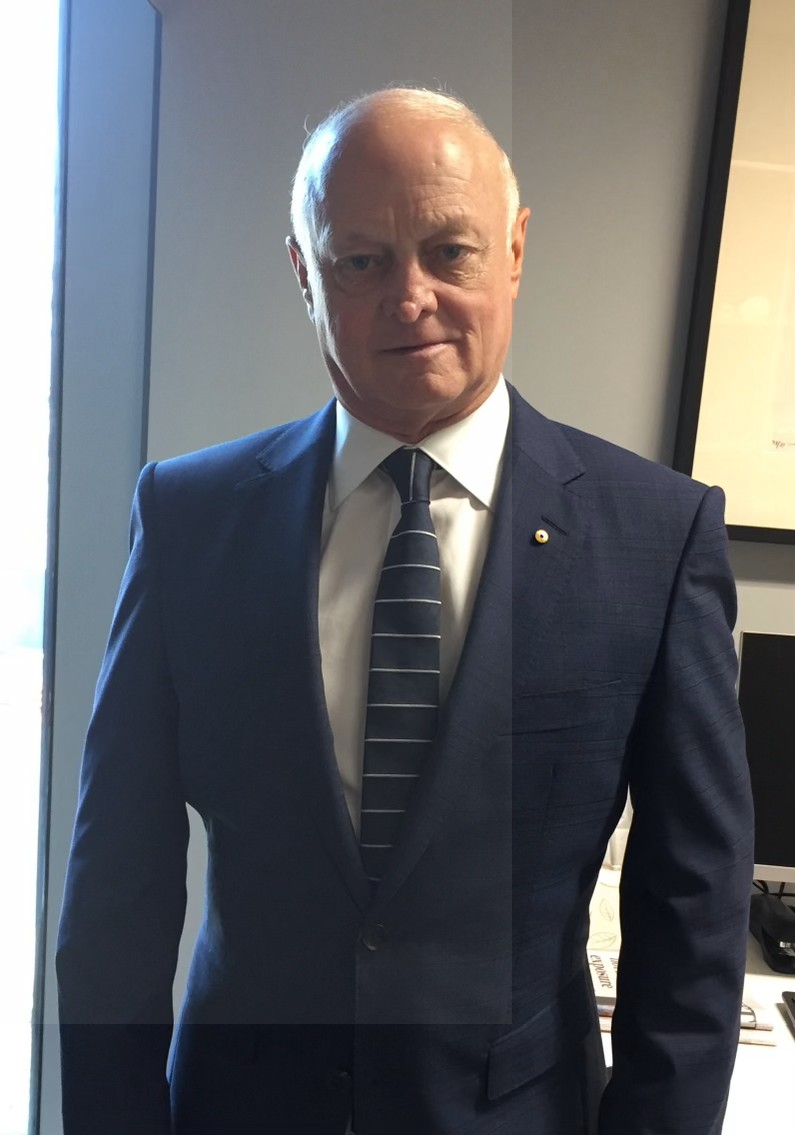
Professor Robert Clark AO FAA DistFRSN
Robert Clark was formerly Chief Defence Scientist (CDS) in the Australian Department of Defence, CEO of the Defence Science and Technology Organisation and a member of Australia’s Defence Committee.
In his early career he was educated at the Royal Australian Naval College (RANC), HMAS CRESWELL, Jervis Bay and UNSW, and served as a seaman officer in a number of RAN warships and was a HMAS PENGUIN-qualified ships diver in the Royal Australian Navy. At RANC he was awarded the E.E.Mayo Prize for academic performance and the RNZN-endowed Navigation Prize following sea training in HMAS ANZAC. He completed his Operations and Weapons training with the Royal Navy, UK and was awarded his Full Bridge Watchkeeping Certificate whilst serving in HMAS STUART.
Subsequently he was a University Lecturer and Fellow & Praelector and member of the governing body of The Queen’s College at the University of Oxford, heading a research group investigating quantum effects in semiconductors at Oxford’s Clarendon Laboratory. Returning to Australia, he was a Scientia Professor and Chair Professor of Experimental Physics at the University of New South Wales. His academic qualifications are a UNSW BSc and PhD and an Oxford MA by special resolution.
As an inaugural Australian Government Federation Fellow, he was the founding Director of the Australian Research Council Centre of Excellence for Quantum Computer Technology, which he led over its first decade – focused on both silicon and optical quantum computing – that established Australia’s credentials internationally in this disruptive technology. In particular he established the Centre’s foundational semiconductor nanofabrication and ultra-low-temperature quantum measurement infrastructure that underpinned the Centre’s core capability.
In his CDS role, that took him to Afghanistan on several operationally-focused visits associated with force protection during that conflict, he was the Australian Principal of The Technical Cooperation Program (TTCP) between Australia, the US, the UK, Canada and New Zealand and a member of the Prime Minister’s Science, Engineering and Innovation Council.
More recently he has been a Senior Fellow of the Australian Strategic Policy Institute, and has held several UNSW positions and Board roles, including Chair of Energy, Strategy and Policy in the Faculty of Engineering, Chief Scientist in Residence at COFA where with COFA colleagues he established the EPICentre facility, and senior advisor to the Vice Chancellor.
He is a Fellow of the Australian Academy of Science and a Distinguished Fellow of the Royal Society of New South Wales and currently has strategic advisory roles in the Australian university sector (UNSW Engineering, UNSW Canberra and Swinburne University).
He has been privileged to receive a number of awards and honours, that include the Boas Medal of the Australian Institute of Physics, Mott Lecturer of the UK Institute of Physics, the Australian Museum CSIRO Eureka Prize for Leadership in Science, the Australian Centenary Medal, the Australian Defence Medal, the United States of America Secretary of Defence Medal for Outstanding Public Service and two medal awards for distinguished service from US government agencies.
He is an Officer in the Order of Australia, awarded for his leadership of the scientific community of the Australian Defence Force, and contribution to quantum computing.
He has an interest in running and has in recent times completed the New York City, Berlin, Paris and two Tokyo marathons.