Professor Lene Vestergaard Hau
Mallinckrodt Professor of Physics and of Applied Physics, Harvard University
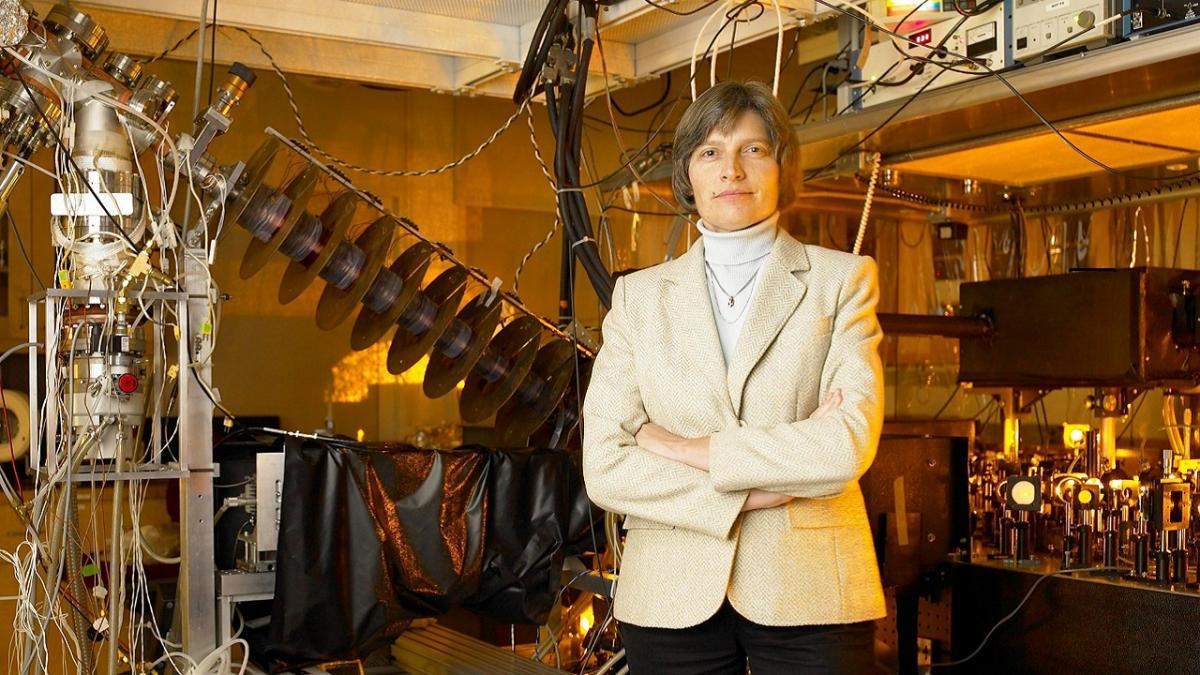
Lene Vestergaard Hau is the Mallinckrodt Professor of Physics and of Applied Physics. Prior to joining the Harvard faculty in 1999, she was a senior scientist at the Rowland Institute for Science in Cambridge, Massachusetts, and holds a Ph.D. in Physics from University of Aarhus, Denmark. Hau led a team who succeeded in slowing a pulse of light to 24 kilometres per hour and also brought light to a stop. They took matters even further as they stopped and extinguished a light pulse in one part of space, and subsequently revived it in a different location. In the process, the light pulse is converted to a perfect matter copy that can be stored – put on the shelf – sculpted, and then turned back to light. These results represent a new paradigm for quantum information processing.
Hau has contributed to a wide variety of research fields. Her Ph.D. work was in theoretical condensed matter physics and she later shifted her attention to experimental and theoretical optical and atomic physics. Her research has included studies of ultra-cold atoms and superfluid Bose-Einstein condensates, as well as channelling of high-energy electrons, protons, and positrons in single crystals with experiments at CERN and Brookhaven National Laboratory.
She is a 2001 MacArthur Fellow and was elected to the American Academy of Arts and Sciences, the Royal Swedish Academy of Sciences, and the Royal Danish Academy of Sciences and Letters. She is a member of the European Research Council and is a Fellow of the American Association for the Advancement of Science and of the American Physical Society. Hau is also the recipient of numerous awards, including Harvard University’s Ledlie Prize, the Ole Roemer Medal, awarded by the University of Copenhagen, and the Richtmyer Memorial Lecture Award awarded by the American Association of Physics Teachers. In 2010, she was named “World Dane”, and in 2012 “Thomson Reuters (Clarivate) Citation Laureate in Physics”. In 2018 she was honoured with the Lise Meitner Distinguished Lecture and Medal, sponsored by The Royal Swedish Academy of Sciences through its Nobel Committee for Physics, and in March of this year with the International Research Prize from the Olav Thon Foundation, in Oslo.
Professor Hau’s research is described on RadioLab’s “Master of the Universe.”